CLUSDT is oil on Binance. You trade it like any crypto pair: long, short, up to 100x leverage, around the clock. The entry bar is low, from 5 USDT. But oil does not behave like bitcoin or gold, and this contract has its own traps.
Let's go through it in plain words: how CLUSDT works, what happens on weekends, what it costs to hold a position, and where the leverage sits right now. Numbers are from October 10.
What CLUSDT is
CLUSDT is the Binance perpetual futures contract on WTI crude oil (the US oil benchmark). It launched on April 1, 2026, together with Brent (BZUSDT) and natural gas (NATGASUSDT). On its first day CLUSDT traded about $760M.
The key specs:
- 1 contract = 1 barrel of oil, priced in USDT;
- minimum trade 0.01 barrel, minimum order 5 USDT;
- tick size 0.01 USDT;
- no expiry: you can hold a position as long as your margin holds;
- settled in USDT: you never receive or deliver physical oil.
WTI and Brent are two different grades of oil with different prices. Brent is usually a bit more expensive. When the news says "oil is up", it usually means one of them, so check which ticker you are trading.
How CLUSDT differs from regular oil
Classic oil trades on exchanges like NYMEX: contracts have an expiry date, you have to roll them into the next month, and trading follows a schedule. CLUSDT works differently:
- trades 24/7, including weekends;
- leverage up to 100x;
- no rolling: instead of an expiry date, funding keeps the price close to oil;
- liquidations: with high leverage, the exchange closes your position if price moves against you.
Leverage: 100x only for small positions
The maximum 100x applies only to positions up to $50,000. After that the limit drops:
| Position size | Max leverage | Maintenance margin |
|---|---|---|
| up to $50,000 | 100x | 0.5% |
| $50,000 - $400,000 | 75x | 0.65% |
| $400,000 - $1M | 50x | 1% |
| $1M - $4M | 25x | 2% |
| $4M - $8M | 20x | 2.5% |
What this means in practice. At 100x, the position is liquidated after a move of about 0.5% against you. For oil that is not even a move: a normal day easily gives 1-2%, and news days give more. On top of that, the exchange charges a 1.5% liquidation fee.
You can work out your own liquidation price in the futures calculator: enter entry, leverage and margin.
Funding: every 4 hours
Instead of an expiry date, CLUSDT has funding. Every 4 hours one side pays the other:
- positive funding: longs pay shorts;
- negative funding: shorts pay longs;
- cap per payment: ±0.5%.
On October 10 funding was 0%. It usually sits near zero, but it is charged 6 times a day and calculated on the full position, not on your margin. With high leverage even a small rate eats a noticeable part of the deposit over a week.
Binance also warns that when the main oil market is closed, funding can change more than usual.
Weekends: the main oil trap
The main oil market is closed from Friday evening to Sunday evening UTC. CLUSDT keeps trading. Three things follow from that.
1. On weekends, only futures traders move the price. Volume is lower, the order book is thinner, and price is easier to push.
2. On Monday there can be a gap. If news came out over the weekend (OPEC, the Middle East, sanctions), the main market opens higher or lower, and CLUSDT adjusts to that price. A high leverage position may not survive until Monday.
3. Binance can switch on "Reduce only" mode. The exchange says that on weekends some pairs allow only orders that reduce a position. That means you cannot open a new position, only close or cut it. If you planned to buy a dip on Saturday, you may not get the chance.
The screenshots in this article were taken on a Saturday, while the main market was closed.
Why oil moves harder than gold
Gold moves slowly, it reacts to rates and the dollar. Oil reacts to news right away and strongly:
- OPEC+ decisions on output;
- weekly US crude inventory data (out on Wednesdays);
- conflicts and sanctions in producing regions.
So the same leverage is more dangerous on oil than on gold. If you come from gold, lower your leverage. We have a separate guide on gold: Binance gold futures: what to know before trading gold with 100x leverage.
CLUSDT liquidation heatmap: where the leverage sits

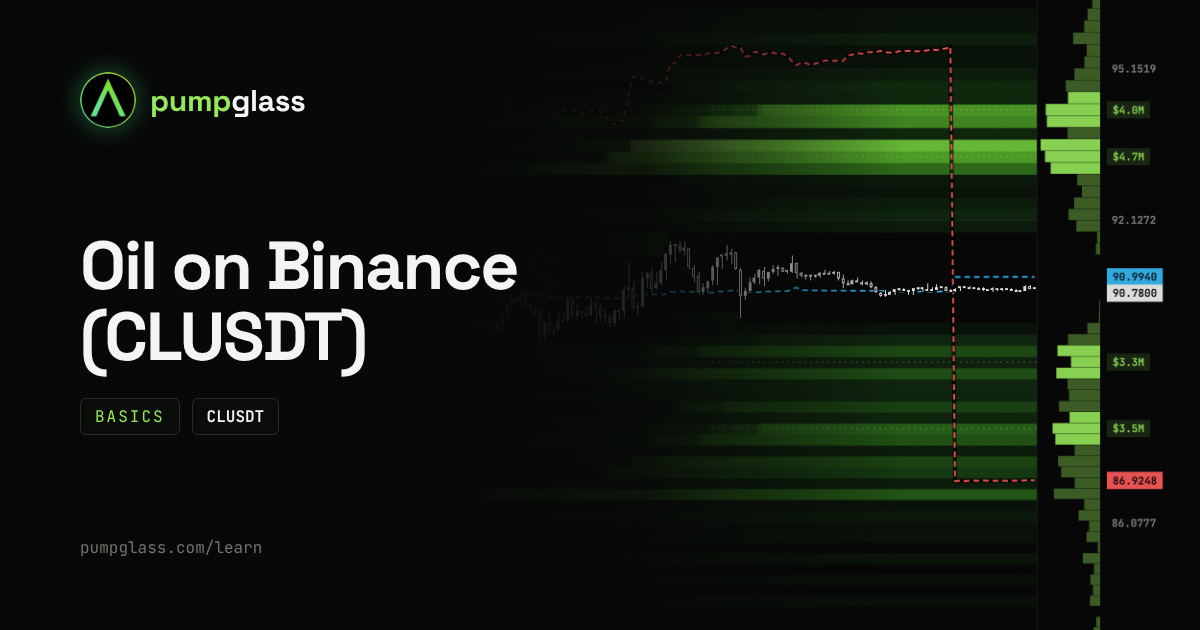
Example on October 2026 data. The numbers on the map change every minute, the current picture is on the CLUSDT map.
Price is 90.78. Here is what the map shows:
Above the price (shorts get liquidated here):
- $4.7M near 93.39 (+2.9%);
- $4.0M near 94.33 (+3.9%).
Below the price (longs get liquidated here):
- $3.3M near 89.29 (-1.6%);
- $3.5M near 87.96 (-3.1%).
Below, the bands are closer to the price. Above, they are bigger. A short liquidation is a market buy, a long liquidation is a market sell. So if price reaches one of the bands, the move can speed up because of forced trades. This is not a forecast of direction, it is the setup: where the fuel sits on each side.
How to read this kind of map and why big players care about these levels is covered in detail in the guide Gold liquidation heatmap (XAUUSDT): how to read it.
Order book: a buy wall below the price

The Order book tab shows real limit orders on the exchange. On October 10:
- below the price there is a big buy wall, $8.8M near 89.07. That is right under the long liquidation band at 89.29;
- above the price there are clearly fewer sell orders, the most visible is $3.1M above 95.
How to read this together. To reach the long liquidations at 89.29 and below, price has to go through the buy wall. While it stands, it works as a cushion. If the wall disappears as price comes close, the cushion is gone. Walls can be pulled at any moment, so watch whether it holds, not just whether it is there.
Whales vs the crowd

Here is how positions looked on October 10.
Whales are mostly short. Among large traders only 34% are long. A week ago it was 25%, so whales are slowly adding longs, but most are still against a rise.
The crowd is split almost evenly. Regular traders are 48% long. Unlike gold and silver, there is no crowd skew.
Whale shorts are twice as big. 78 whales in shorts hold $49.9M, 100 whales in longs hold $25.9M.
Average entries:
- whale longs entered at 90.99 on average. Price is 90.78, so they are almost at zero: +0.3% to break even;
- whale shorts entered at 86.92 on average. Price is higher, so their shorts are down $2.1M, and price needs to fall 4.2% for them to break even.
Now put this together with the map. Whale shorts are already in loss, and the short liquidation bands sit above at 93.39 and 94.33. If price heads there, pressure on short sellers grows from two sides: small leveraged shorts get liquidated, and the big ones see their loss grow.
How not to get it wrong: the jump in the short line
Look at the right edge of the map: on October 10 the red dashed line (whale average short entry) dropped in a vertical line, from about 95 to 86.92.
That does not mean whales re-entered their shorts at a new price in one minute. This happens when the group of large traders itself gets updated: some leave the group, others join, and the average price is recalculated from scratch.
The rule is simple: a vertical jump in the line is a change in the group, not a trade.
FAQ
What is CLUSDT on Binance?
A perpetual futures contract on WTI crude oil, settled in USDT. One contract equals one barrel. Leverage up to 100x, trading 24/7, no expiry.
Can you trade oil on Binance on weekends?
Yes, CLUSDT trades on weekends even though the main oil market is closed. But Binance can switch on "Reduce only" mode, and then you cannot open a new position. On Monday the price can adjust sharply to the open of the main market.
What is the maximum leverage on oil on Binance?
100x, but only for positions up to $50,000. Larger positions get lower limits: 75x up to $400,000, 50x up to $1M, and so on by tier.
How often is funding charged on CLUSDT?
Every 4 hours, 6 times a day. The cap per payment is ±0.5%. Outside the main market hours the rate can change more.
What is the difference between CLUSDT and BZUSDT?
CLUSDT is WTI oil (the US benchmark), BZUSDT is Brent (the North Sea, global benchmark). They are different grades with different prices, Brent is usually a bit more expensive.
Where can I see liquidations and whale positions on oil?
On PumpGlass, at /heatmap/CLUSDT: the liquidation heatmap, order book and whale average entries for oil are free and update once a minute.
PumpGlass shows market data. It is not financial advice.