On Binance you can trade gold the same way you trade bitcoin: long, short, with leverage, around the clock. That is the XAUUSDT futures contract. It looks like a familiar crypto pair, but it has a few differences worth understanding before the first trade.
Let's go through how the contract works, how it differs from regular gold, what happens on weekends, and what data to check before you enter. The numbers come from the contract specs and from PumpGlass maps on October 9 and 10.
What XAUUSDT is
XAUUSDT is the Binance perpetual futures contract on gold. Binance launched it in January 2026 together with silver (XAGUSDT).
The key specs:
- One contract is one troy ounce of gold, priced in USDT.
- Minimum trade is 0.001 ounce, minimum order size is 5 USDT. You can enter with a very small amount.
- Tick size is 0.01 USDT.
- No expiry. You can hold a position as long as you want, as long as your margin holds.
- Settlement and margin in USDT. You never receive or deliver physical gold.
How it differs from regular gold
When you buy gold from a broker or on a metals exchange, you buy the asset itself or a classic futures contract with a delivery date. XAUUSDT works differently:
- 24/7 trading. Including weekends and holidays, when the main gold market is closed.
- Leverage up to 100x. You rarely see leverage like that on the classic market.
- Funding. Instead of an expiry date, the contract stays close to the gold price through regular payments between longs and shorts.
- Liquidations. With high leverage, the exchange closes your position if price moves against you.
Let's go through each of these.
Leverage: up to 100x, but not for everyone
The maximum 100x leverage applies only to positions up to $50,000. After that, the limit drops:
| Position size | Max leverage | Maintenance margin |
|---|---|---|
| up to $50,000 | 100x | 0.5% |
| $50,000 - $400,000 | 75x | 0.65% |
| $400,000 - $1M | 50x | 1% |
| $1M - $4M | 25x | 2% |
| $4M - $8M | 20x | 2.5% |
Why this matters. Gold usually moves more calmly than crypto, and many traders use high leverage to "speed up" the move. But at 100x, a move of less than 1% against you is enough to get liquidated. And the exchange charges an extra 1.5% liquidation fee on top.
Funding: who pays whom
A perpetual contract has no expiry date, so its price is tied to gold through funding. Every 4 hours, one side pays the other:
- Positive funding: longs pay shorts. This happens when more traders want to buy the futures and its price sits above the gold price.
- Negative funding: shorts pay longs.
- Cap per payment: ±0.5%.
In practice, funding on gold is usually close to zero. Over the week of October 3 to 10 it ranged from 0% to about 0.017% per 4 hours, and on October 10 it was at zero.
The payment is small, but it is charged 6 times a day and calculated on the full position, not on your margin. At 50x leverage, even 0.01% per payment adds up to a noticeable part of your margin over a week.
Weekends: gold is closed, XAUUSDT keeps trading
This is the main difference, and few traders think about it.
The main gold market closes for the weekend, from Friday evening to Sunday evening UTC. XAUUSDT keeps trading the whole time.
What follows from that:
- On weekends, price is moved mostly by futures traders. The big players of the main market are not active, so volumes are lower and moves can be sharper.
- On Monday the regular market opens. If news came out over the weekend, gold can open noticeably higher or lower, and XAUUSDT will adjust to that price. High leverage positions opened over the weekend are exposed to that move.
- Funding is charged on weekends too. Holding a position from Saturday to Monday means paying or receiving funding 12 times.
The practical takeaway: if you hold gold with high leverage over the weekend, you take on the risk of the Monday open, not just the moves within the week.
Liquidations: where the leverage sits on gold
With leverage up to 100x, there are a lot of liquidations on gold, and they cluster at certain prices. You can see this on the liquidation heatmap.

Example on October 2026 data. The numbers on the map change every minute, the current picture is on the XAUUSDT map.
On the October 9 map, with price at 4,196:
- above the price there was $28.1M of short liquidations near 4,280 (+2%), plus a small $9.8M band very close, near 4,228;
- below the price, $26.2M of long liquidations near 3,990 (-5%).
How to read this map, why big players care about these levels, and what a liquidation cascade is, we covered in a separate guide: Gold liquidation heatmap (XAUUSDT): how to read it.
What to check before a trade: whales vs the crowd
Price shows where gold has already been. Positions show how the money is placed right now. Here is what XAUUSDT looked like on October 10.

The crowd is long, the whales are short. Among regular traders, 77% are long. Among large traders, only 40%. The gap is almost 40 points: the crowd is betting on a rise, while most of the whale money stands against it.
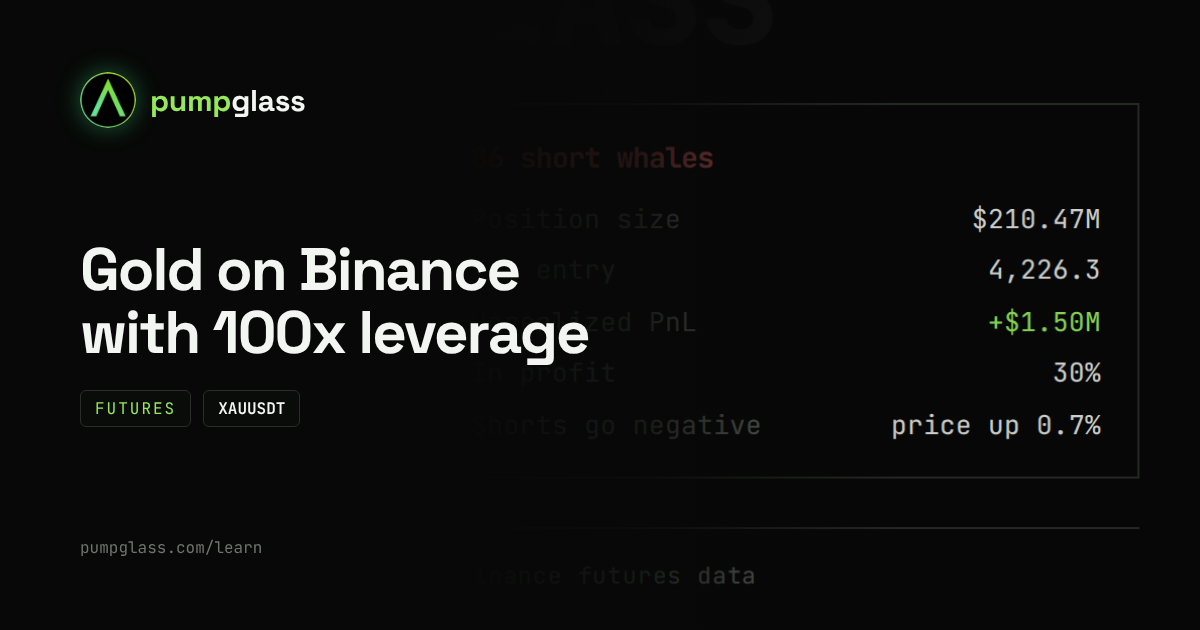
By count whales lean long, by money they lean short. There are 130 large traders in longs with positions worth $139M. In shorts there are only 86, but with positions worth $210M. Fewer short whales, but noticeably bigger ones.
Whales added longs over the week. A week ago, 29% of whales were long. Now it is 40%. Most are still short, but the skew has narrowed.
Whale longs are in loss, whale shorts are in profit, but with a thin margin.
- The whale average long entry is 4,347. Price is 4,196, so their longs are down $5M. Gold needs to rise 3.6% for them to break even.
- The whale average short entry is 4,226. Their shorts are up $1.5M. But a rise of just 0.7% would push whale shorts into loss.
Now put this together with the liquidation map. The whale average short entry (4,226) almost matches the nearest band of short liquidations (near 4,228). If price reaches that zone, leveraged short liquidations fire at the same time as large shorts get back to break-even. That is a place worth marking in advance.
This is not a forecast of a rise. It is a map of where the sensitive prices sit for different groups of traders.
Open interest: how much money is in the contract

Open interest is the total size of open positions in the contract. On gold it grew a lot over the past month:
- around 90K ounces in mid-September;
- about 200K at the peak on October 7;
- 144.9K ounces on October 10, roughly $608M.
Rising open interest means new money and new leveraged positions are entering the contract. A drop after the peak means some positions were closed or wiped out. The more open interest, the more fuel for the liquidations on the map.
Silver, oil and stocks
All of this works the same way for other traditional assets on Binance Futures: silver (XAGUSDT), oil, tokenized stocks. Leverage, funding and weekend trading work the same, and whale positions, liquidation heatmaps and the order book for them are on PumpGlass. For example, the silver liquidation heatmap.
FAQ
Can you trade gold on Binance on weekends?
Yes. XAUUSDT trades 24/7, including weekends, even though the main gold market is closed at that time. Keep in mind that on Monday the price can adjust sharply to the open of the regular market.
What is the maximum leverage on gold on Binance?
Up to 100x, but only for positions up to $50,000. Larger positions get lower limits: 75x up to $400,000, 50x up to $1M, and so on by tier.
How often is funding charged on XAUUSDT?
Every 4 hours, so 6 times a day. The cap per payment is ±0.5%. Most of the time, funding on gold is close to zero.
Does the XAUUSDT price match the gold price?
Almost always it stays close, funding keeps it there. But on weekends, when the main market is closed, the futures price can move away from Friday's close.
Do I get physical gold?
No. XAUUSDT is a contract on the gold price, all settlement is in USDT.
Where can I see whale positions on gold?
On PumpGlass: whale and crowd positions, whale average entries, open interest, liquidations and the order book for XAUUSDT are free to view.
PumpGlass shows market data. It is not financial advice.