On Binance you can trade Tesla stock without opening a brokerage account. TSLAUSDT is a futures contract on the stock: long, short, leverage, around the clock, settled in USDT. It looks like a regular crypto pair, but it has a feature few people think about: most of the time it trades while the stock exchange is closed.
Let's go through it in plain words: how TSLAUSDT works, how it differs from buying the stock itself, when holding a position is most dangerous, and where the leverage sits. The map and position examples use data from October 10, and current numbers are always on the free map.
What TSLAUSDT is
TSLAUSDT is the Binance perpetual futures contract on Tesla stock (TSLA, Nasdaq). It launched on January 28, 2026, as the first stock futures contract on Binance. Nvidia (NVDAUSDT), Apple, Amazon and others followed.
The key specs:
- 1 contract = 1 Tesla share, priced in USDT, minimum trade 0.01 share;
- minimum order 5 USDT;
- no expiry: you can hold a position as long as your margin holds;
- settled in USDT: you never receive shares, and there are no dividends or voting rights.
How it differs from buying the stock
When you buy a share from a broker, you own it: a 20% drop is a 20% loss, and nobody closes your position. TSLAUSDT is different:
- leverage: you can open a position bigger than your money, but then it gets closed if price moves against you;
- shorting is as easy as going long;
- funding: holding a position costs money (or earns it);
- 24/7 trading, not only during exchange hours.
Do not confuse TSLAUSDT with tokenized stocks. A token works like buying the stock without leverage. The futures contract is a bet on the price with leverage and liquidation risk.
Leverage
The maximum leverage is 25x, and only for positions up to $150,000. After that the limit drops. Note the maintenance margin: 2%, compared to 0.5% on gold and oil. The exchange keeps a bigger buffer because stocks move harder.
| Position size | Max leverage | Maintenance margin |
|---|---|---|
| up to $150,000 | 25x | 2% |
| $150,000 - $300,000 | 20x | 2.5% |
| $300,000 - $750,000 | 15x | 3.33% |
| $750,000 - $3M | 10x | 5% |
| $3M - $10M | 5x | 10% |
What this means in practice. At 25x, the position is liquidated after a move of about 2% against you. Tesla easily moves 3-5% in a day, and more than 10% on earnings and news. So 25x may not survive an ordinary day. At 10x the buffer is about 8%. On top of that, the exchange charges a 1.5% liquidation fee. You can work out your own liquidation price in the futures calculator.
Funding
Every 8 hours (3 times a day) one side pays the other:
- positive funding: longs pay shorts;
- negative funding: shorts pay longs;
- cap per payment: ±2%.
The cap here is 4 times wider than on gold and oil (±0.5% there). On October 10 funding was 0%, but when the market is skewed and almost everyone is on one side, the payment can be noticeable.
Funding is calculated on the full position, not on your margin. With leverage, even a small rate eats a noticeable part of the deposit over a week.
The main feature: the exchange is almost always closed
The regular Nasdaq session runs 6.5 hours on weekdays: from 13:30 to 20:00 UTC (while the US is on summer time; one hour later in winter). That is less than 20% of the week. The rest of the time, at night and all weekend, TSLAUSDT trades without its main market.
What follows from that:
1. At night and on weekends, only futures traders move the price. The order book is thinner and price is easier to push. The screenshots in this article were taken on a Saturday: the exchange was closed, and TSLAUSDT was up more than 1% over the day.
2. There can be a gap when the exchange opens. If news came out overnight or over the weekend, the stock opens higher or lower, and the futures price adjusts to it. A leveraged position may not survive until the open.
3. Quarterly earnings. Tesla reports after the market closes. The reaction to a report is often a few percent in one evening, sometimes more than 10%, and TSLAUSDT goes through that move right away, while the exchange is closed.
4. Company and CEO news. Tesla is one of the most news-driven stocks: statements, deliveries and regulator decisions move it more than the market.
Binance warns that outside main market hours liquidity is lower and funding can change more than usual. On weekends, for some of these pairs, the exchange can switch on "Reduce only" mode: you can close a position, but you cannot open a new one.
Example: TSLAUSDT liquidation heatmap on October 10
Below is a breakdown on real data from one day. The numbers on the map change every minute, the current picture is on the TSLAUSDT map. The way to read it does not depend on the date.
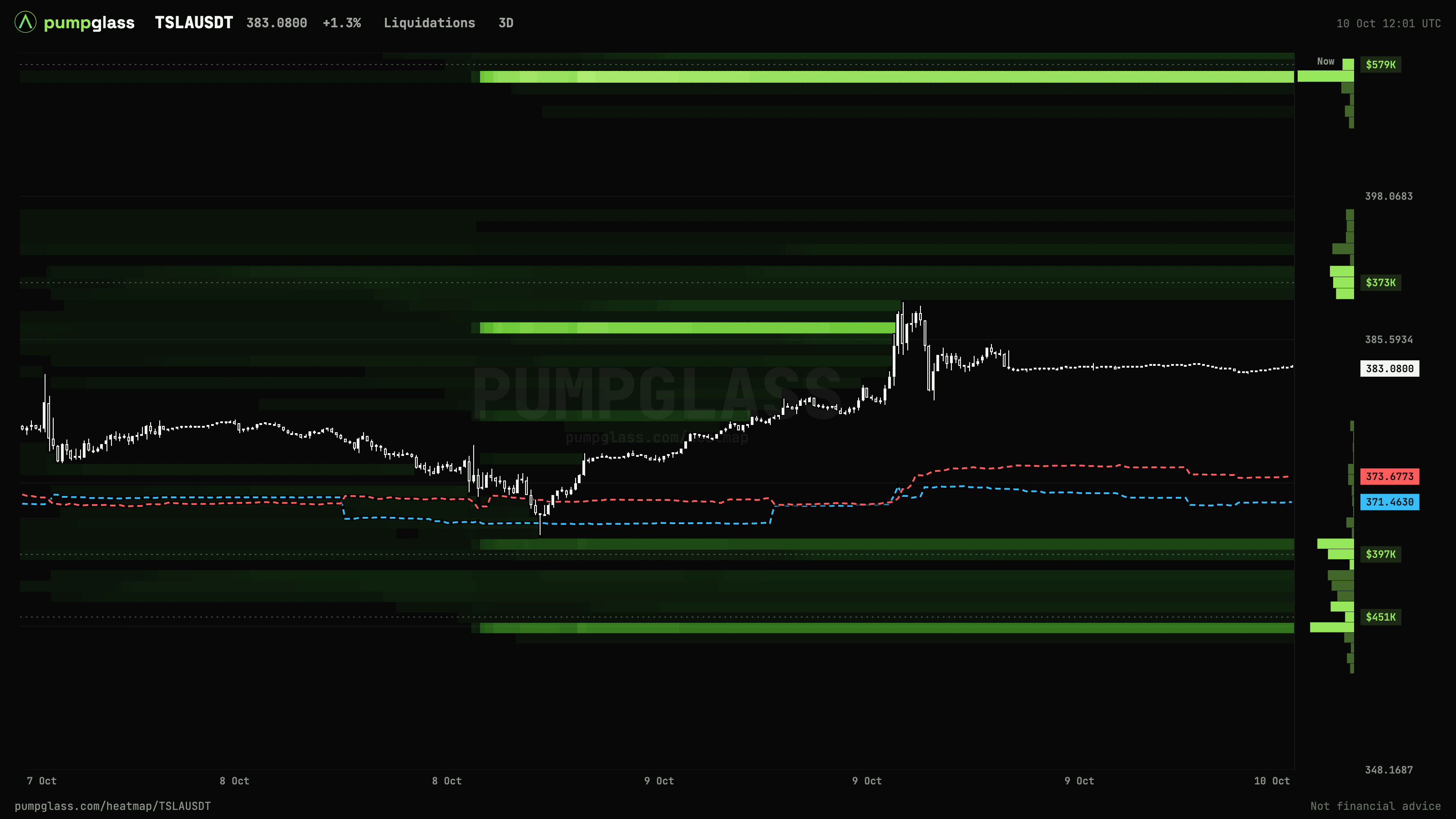
Price is 383.08. Here is what the map shows:
Above the price (shorts get liquidated here):
- $373K near 390 (+1.9%);
- $579K near 410 (+6.9%).
Below the price (longs get liquidated here):
- $397K near 367 (-4.2%);
- $451K near 361 (-5.7%).
Note the amounts: hundreds of thousands of dollars, not millions like on bitcoin or oil. The stock futures market is still thin. So even a small wave of liquidations moves the price noticeably here.
The map shows one more thing: a wide band near 386-387 disappeared on October 9, when price ran through it with a wick. That is how the map works: a level burns out when price touches it.
Example: TSLAUSDT order book on October 10
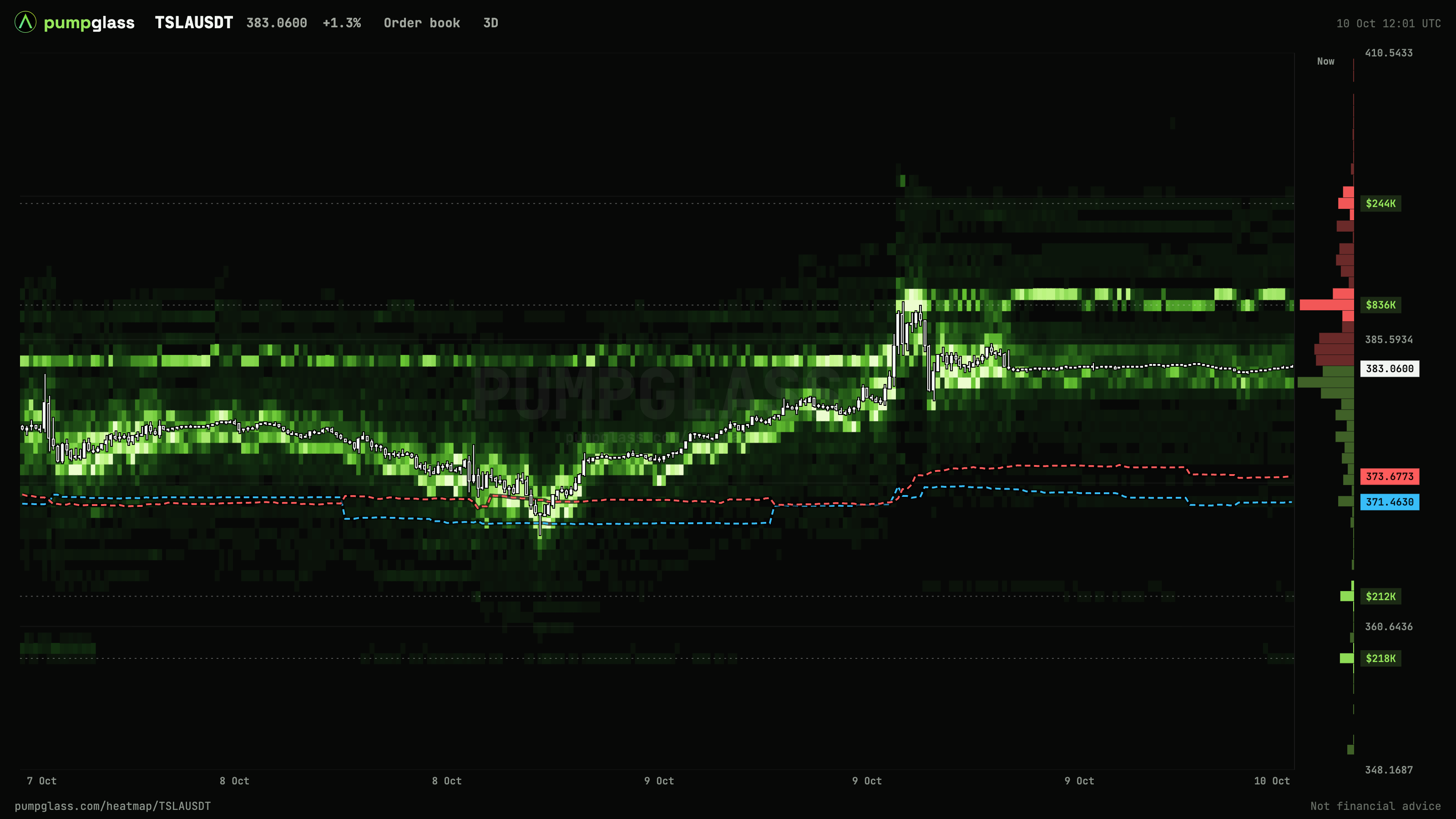
The Order book tab shows real limit orders. On October 10:
- above the price the biggest sell order is $836K near 388.6. That is right in front of the short liquidations at 390;
- below the price buy orders sit densely right at the current price, then notable levels of $212K near 362 and $218K near 357.
How to read this together with the liquidation map. To reach the shorts at 390, price first has to eat through the sell orders at 388.6. If those orders are pulled as price comes close, the way to the short band opens.
Example: whales vs the crowd on October 10
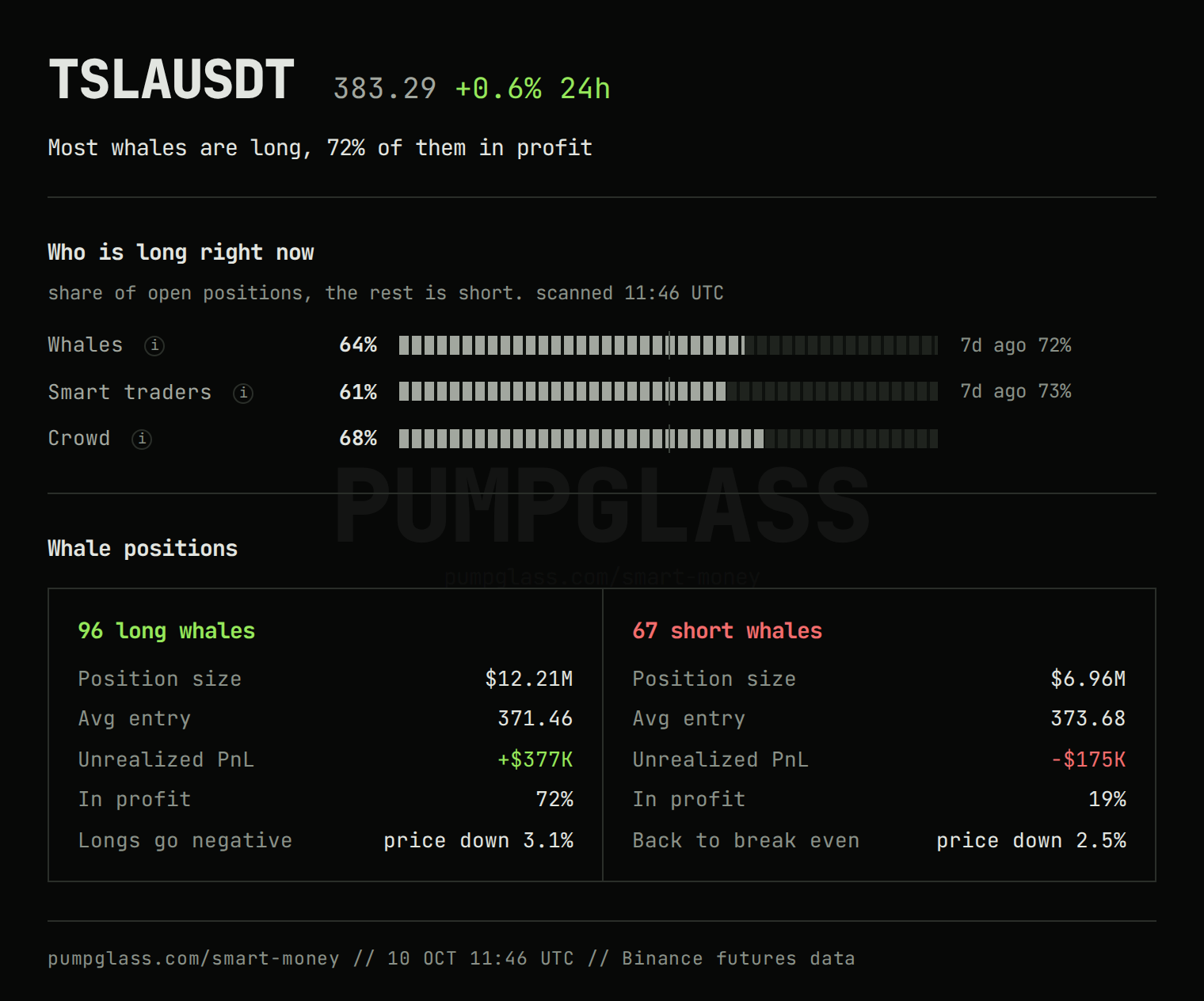
Here is how positions looked on October 10.
Almost everyone is long. Whales are 64% long, the crowd 68%. There is almost no gap.
But whales are cutting longs. A week ago 72% of whales were long, now 64%. The Smart traders group cut even harder: from 73% to 61%.
By money, longs lead. 96 whales in longs hold $12.2M, 67 whales in shorts hold $7.0M.
Average entries:
- whale longs entered at 371.46 on average. They are up $377K and go into loss on a 3.1% drop;
- whale shorts entered at 373.68. They are down $175K, and price needs to fall 2.5% for them to break even.
Now put this together with the map. The whale average entries sit around 371-374, and below them, near 367 and 361, are the long liquidation bands. If price drops 3-4%, whale longs go to zero, and right after that leveraged long liquidations start to fire. This is not a forecast, it is the setup: where the sensitive prices of different groups sit.
FAQ
Can you trade Tesla stock on Binance?
Yes, through the TSLAUSDT futures contract. It is a contract on the stock price, settled in USDT. You do not receive the share itself, and there are no dividends.
What is the leverage on TSLAUSDT?
Up to 25x, but only for positions up to $150,000. After that 20x up to $300,000, 15x up to $750,000, 10x up to $3M, and lower.
Does TSLAUSDT trade on weekends?
Yes, around the clock and on weekends, even though Nasdaq is closed. On Monday, when the exchange opens, the price can adjust sharply. On weekends Binance can switch on "Reduce only" mode.
What is the difference between TSLAUSDT and tokenized stocks?
A tokenized stock works like buying the stock without leverage. TSLAUSDT is a futures contract: it has leverage, shorting, funding and liquidation risk.
What other stocks are on Binance futures?
Besides Tesla: Nvidia (NVDAUSDT), Apple, Amazon, Microsoft, Alphabet, Meta and others. PumpGlass has the liquidation heatmap and whale positions for all of them.
Where can I see liquidations and whale positions on Tesla?
On PumpGlass, at /heatmap/TSLAUSDT: the liquidation heatmap, order book and whale average entries are free and update once a minute.
PumpGlass shows market data. It is not financial advice.