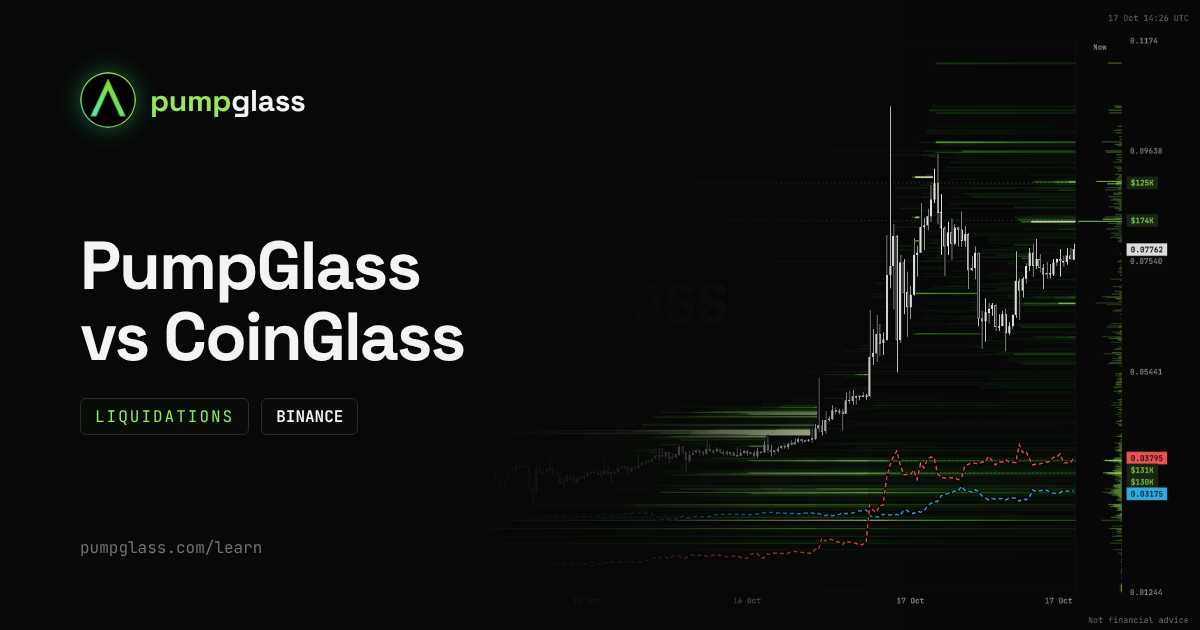
Short answer. If you trade Binance futures and use a liquidation heatmap for the next hours or days, PumpGlass builds its map from Binance's own data, the largest futures exchange where the main liquidity sits, and gives you for free what the CoinGlass map does not have: the real order book and the average entry prices of whales right on the liquidation heatmap, a refresh every minute without a subscription, and any Binance pair without sign-up. CoinGlass is wider in scope: many exchanges, dozens of derivatives data sections and a long history of levels. Below, point by point.
Comparison table
| PumpGlass | CoinGlass | |
|---|---|---|
| Liquidation heatmap price | Fully free | Short ranges free, long ones in paid Prime |
| Sign-up | Not needed | Not needed for the free part |
| Exchanges | Binance, the largest by futures volume | Several exchanges, data combined |
| Pairs | Every Binance USDT futures pair, 700+, including gold, oil and stocks | Coins from different exchanges |
| Real order book on the same map | Yes | No |
| Whale average entries on the map | Yes | No |
| Refresh without paying | Every minute, by itself | By hand, auto refresh in Prime |
| Ranges | 12 hours, 24 hours, 3 days, 7 days | From short ranges to 6-12 months and more in Prime |
| Calculation models | One | Three |
| App | No, the site works on a phone | Yes |
Data about CoinGlass comes from their website on 17 October 2026 and may change.
Why Binance
Binance is the largest crypto futures exchange by trading volume and open interest. Most of the leverage and most of the liquidity sit there, so that is where liquidation levels and order book walls matter most for price.
A combined map across many exchanges adds up venues with different liquidity, different prices and different calculation rules. A big level on Binance gets diluted among small levels from thin exchanges, and the picture becomes less clear. If you trade on Binance, look where the money of that market actually sits. PumpGlass builds the map, the order book and whale entries from Binance's own data.
Where PumpGlass is stronger
Three layers on one map
On PumpGlass the liquidation heatmap, the real Binance order book and the average entries of whales are drawn on one chart. No need to keep three tabs open and compare prices by eye: you see whether a real wall of orders stands next to a big liquidation cluster and at what level the biggest traders got in.

The numbers in these pictures change every minute; the current picture is on the AGT liquidation heatmap.
Whale average entries
Binance publishes the average long and short entry price of its biggest traders for each coin. PumpGlass draws these prices as dashed lines over the map. You see whose positions are in profit and whose are under pressure, and whether the whale level lines up with a liquidation cluster. The CoinGlass map does not have this layer.
The order book, not only an estimate
A liquidation heatmap is a calculation: where leveraged positions burn if price gets there. Real orders are only visible in the order book. On PumpGlass the Order book tab shows Binance limit orders on the same chart and at the same scale, so you can compare the estimate with the facts at once.

Refresh and access
The map and the order book refresh every minute by themselves, for free. Any Binance pair opens without sign-up, including gold XAUUSDT, oil and stocks. The site is in 12 languages.
Where CoinGlass is stronger
- Several exchanges. CoinGlass collects data from different venues. This helps if you do not trade on Binance.
- Long history. CoinGlass has ranges of 6 months and more, in paid Prime. PumpGlass goes up to 7 days.
- More sections. CoinGlass has dozens of derivatives data pages, three liquidation heatmap models and a mobile app.
It is worth being honest about what long history shows. The model knows where positions were opened, but not who has already closed on their own, without liquidation. The older a level, the more of its positions are already gone, yet it stays on the map. So a six-month map tells you more about where positions piled up in the past. For decisions over the next hours and days, fresh levels matter more.
Which one fits you
- You trade Binance futures on a horizon from hours to a week: PumpGlass.
- You want to see the order book and whales next to liquidations: PumpGlass.
- You trade gold, oil or stocks on Binance: PumpGlass.
- You trade on other exchanges, not on Binance: CoinGlass.
- You want to see where BTC positions piled up over many months: CoinGlass Prime.
A comparison with other tools (Hyblock, The Kingfisher, CoinMarketCap) is in Best free liquidation heatmap for Binance futures: 5 tools compared (2026).
FAQ
Is there a free alternative to CoinGlass?
Yes. PumpGlass shows a liquidation heatmap for every Binance futures pair for free and without sign-up, with the order book and whale average entries on the same map and a refresh every minute.
Is the CoinGlass liquidation heatmap free?
Partly. All coins are available on short ranges. Ranges of 6 months and more and auto refresh are in the paid Prime plan.
Is PumpGlass fully free?
The liquidation heatmap, the order book, whale average entries, whales against the crowd and charts are free. The paid Pro subscription adds whale activity history on charts, fresh pump scanner signals and personal alerts in Telegram.
Whose liquidation heatmap is more accurate?
Both maps are an estimate, not a list of real orders. Models are built from changes in open interest and typical leverage and do not know who has already closed. That is why it helps to check the estimate against the real order book, and on PumpGlass it is on the same map.
Why is the map Binance only?
Binance is the largest crypto futures exchange by volume and open interest, with most of the leverage and liquidity. A combined map across many exchanges mixes levels from thin venues with Binance levels, and big levels become less visible. If you trade on Binance, its own data is the more precise view.
Can I use both?
Yes. Many traders look at the long structure on CoinGlass, and at the nearest levels, the order book and whales for a specific Binance pair on PumpGlass.
PumpGlass is made by us. The description of CoinGlass is based on their website on 17 October 2026.
PumpGlass shows market data. It is not financial advice.